Field notes · Nº 05 Leading people
When the same problem appears twice, stop asking who and start asking how.
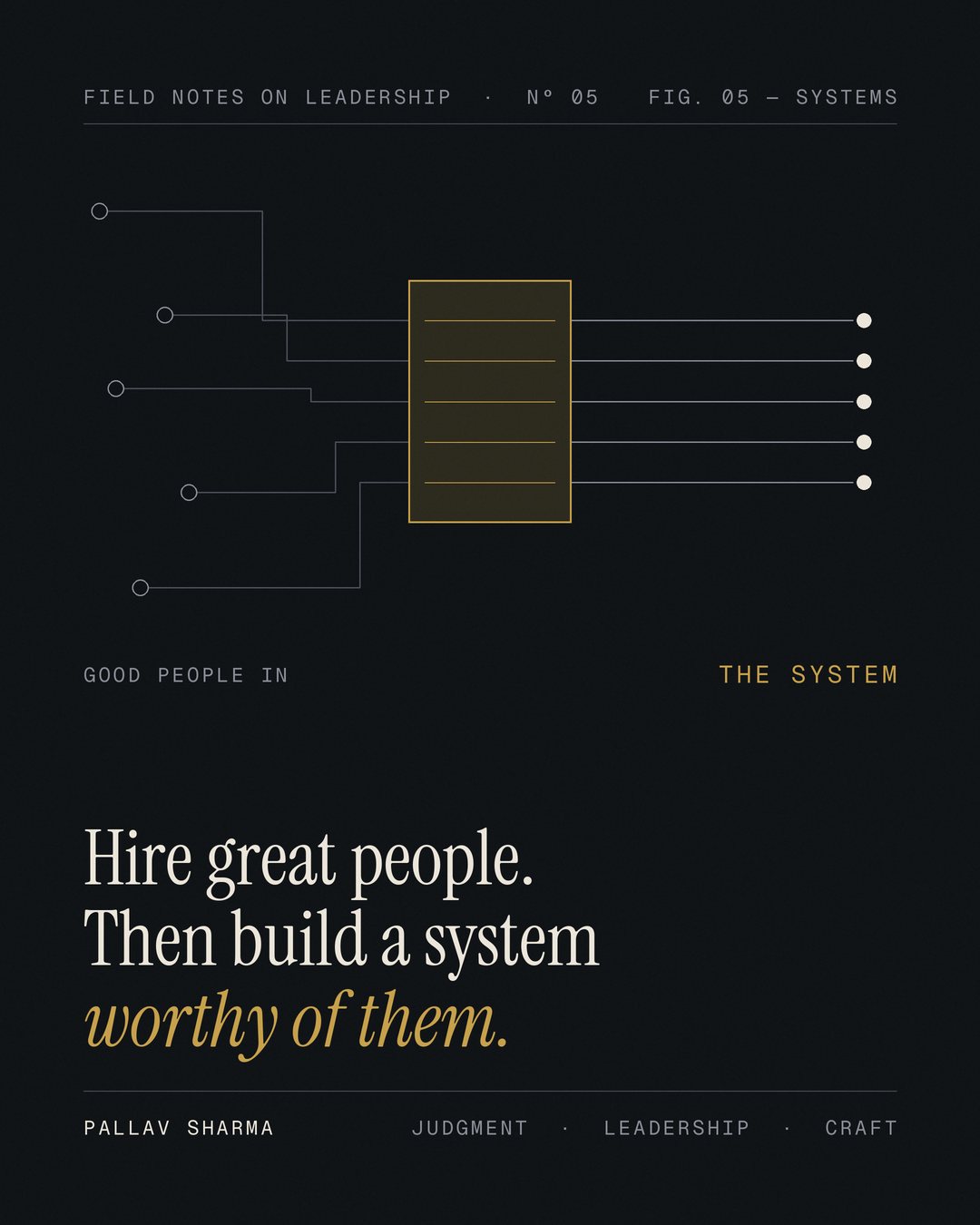
W. Edwards Deming put it plainly: “A bad system will beat a good person every time.”
Behind a missed deadline, a dropped handoff or a repeated defect, look for three suspects: unclear ownership, vague standards, a process nobody designed.
Fix the person and you solve one case.
Fix the system and you solve the cases to come.
A useful test: if a new hire would make the same mistake, the system owns it.
Design how work flows, and good people do their best work by default.
Hire great people. Then build a system worthy of them.
Going deeper
W. Edwards Deming spent his career showing managers that most of the variation in results comes from the system people work in, not from individual effort. For leaders, the idea turns problem-solving from blame into design.
The “who” question and the “how” question
“Who did this?” ends with one person and one fix. “How did our system allow this?” ends with a change that protects everyone who comes after.
A five-step system review
- Describe what happened as a sequence of steps, without names.
- Mark the point where the outcome could have gone differently.
- Ask what made the wrong step easy and the right step hard: missing ownership, an unclear standard, a missing check or a confusing handoff.
- Change one thing in the system: a template, a checklist, a named owner, an automated test or a clearer definition of done.
- Check a month later that the problem has not returned.
The new-hire test in practice
If a capable person joining tomorrow would likely make the same mistake, the system owns the fix. This single question keeps reviews focused on causes and keeps people confident enough to raise problems early.
What well-designed teams look like
Every outcome has a clear owner. “Done” has a written definition. Handoffs are designed on purpose. Reviews look for causes and end with one concrete improvement.
Great people deserve a system that lets their talent show every day.

Co-founder & CTO · About