Field notes · Nº 04 Growth and ambition
Most people collect knowledge. The best let it compound.
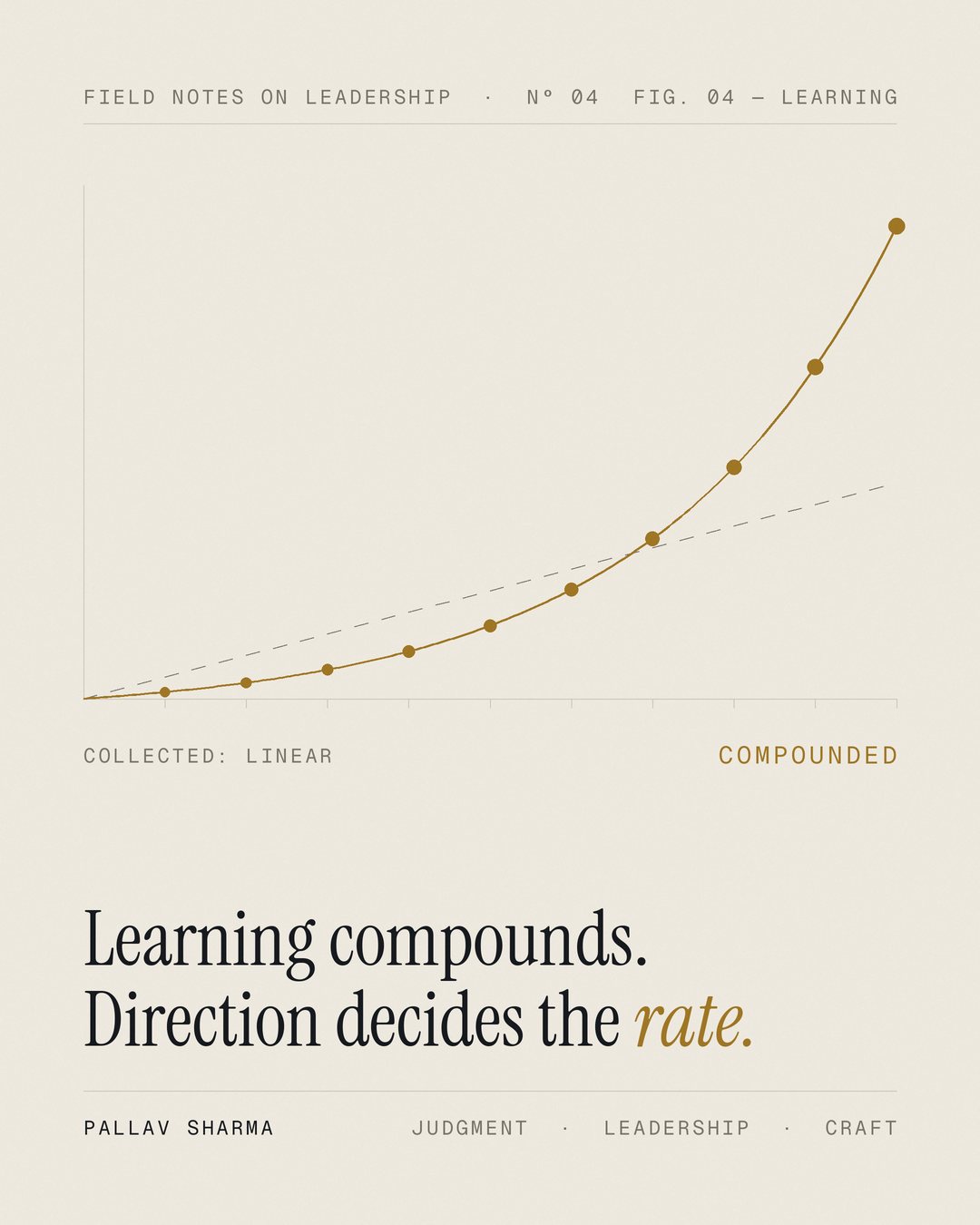
In his essay “Superlinear Returns”, Paul Graham writes that “learning compounds.” He adds: “The more you know, the easier it is to learn new things.”
Collecting is wide. A course here, a book there, a new topic every quarter. Each piece stands alone, so progress stays linear.
Compounding is deep. One direction, held long enough that every idea makes the next one cheaper.
Depth is the fastest route to breadth. Master one field and you enter the next with judgment and standards already in hand. The second field opens faster than the first ever did.
Picture an account whose interest rate rises every year you stay. That is what depth pays.
High performers return to a few fields for years and tie every new idea to one they already own.
The early years look slow. The later years look unfair.
Learning compounds. Direction decides the rate.
Going deeper
In his essay “Superlinear Returns”, Paul Graham argues that the largest outcomes come from things that grow exponentially, and that learning is one of them. The practical question is how to set up your own learning so it compounds instead of piling up in disconnected pieces.
Collecting versus compounding
Collected knowledge is a pile. Compounded knowledge is a structure. When each new idea attaches to something you already understand deeply, it is learned faster, remembered longer and applied with better judgment.
How to make learning compound
- Choose a home field. One domain you will keep deepening for years, ideally the one closest to the work you want to be known for.
- Connect every new idea to it. After reading or learning something new, write one line on how it sharpens what you already know.
- Practise in public. Writing and teaching force clarity and reveal gaps early.
- Return to the fundamentals every year. The classics of a field show new layers each time you come back with more experience.
- Expand from strength. Enter adjacent fields through the lens of your home field, where your judgment already transfers.
What it looks like in strong teams
Teams compound too. They keep decision logs, turn every project review into a reusable playbook, and pair experienced people with newer ones so knowledge moves through the team instead of staying with individuals. Each project then starts from a higher base than the last.
The steady years of depth are the ones that make later leaps look effortless.

Co-founder & CTO · About