Field notes · Nº 05 Leading people
Ownership is three things handed over together: the outcome, the authority and the context.
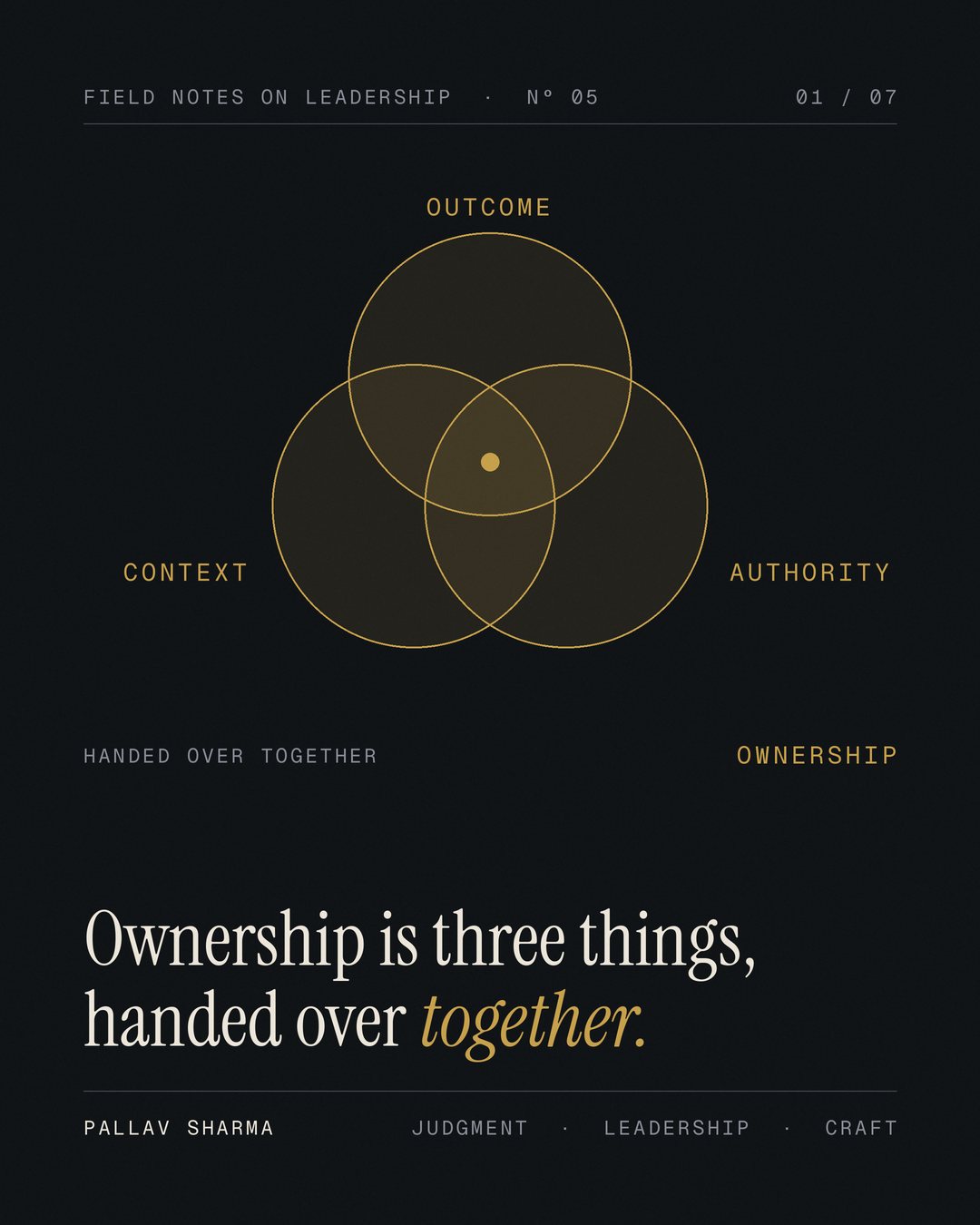
Hand over fewer, and you have delegated a task.
Outcome without authority becomes waiting.
Authority without context becomes guessing.
Context without an outcome becomes drift.
The test: can they make the next decision without you?
Give the whole job, and people grow to its size.
Going deeper
Delegation is how a leader’s judgment scales beyond their own calendar. It works only when the person receiving the work can act without returning for permission at every turn.
Why the three parts travel together
The outcome tells someone where the finish line is. Authority lets them move toward it. Context lets them choose well when the plan meets reality. Each part covers a gap the other two leave open, which is why handing over one or two produces motion without ownership.
The cost of a partial handover is easy to miss. Work keeps moving, but every real decision still waits for the leader, and the leader becomes the limit on how fast the team can go. A full handover removes that limit and gives the person a job large enough to grow into.
A five-step handover
- Write the outcome in one sentence, with how both of you will know it has been reached.
- List the decisions that are theirs: budget limits, trade-offs they can make, people they can involve, and the few calls that still come back to you.
- Share the context you carry: why this matters now, what has been tried, the constraints, and the risks you see.
- Agree on the rhythm: when you will review progress, and what kind of news should reach you early.
- Close with the test: ask what their next decision will be, and how they will make it.
What it looks like in strong teams
Owners announce decisions instead of asking for them. Reviews focus on outcomes and reasoning. Leaders spend their time on context, the one part only they can supply, and the team’s capacity grows with every handover.
Ownership given whole is the fastest way to grow leaders.

Co-founder & CTO · About