Field notes · Nº 03 Judgment
The best leaders don't wait for certainty. They decide how reversible a decision is, then set their speed to match.
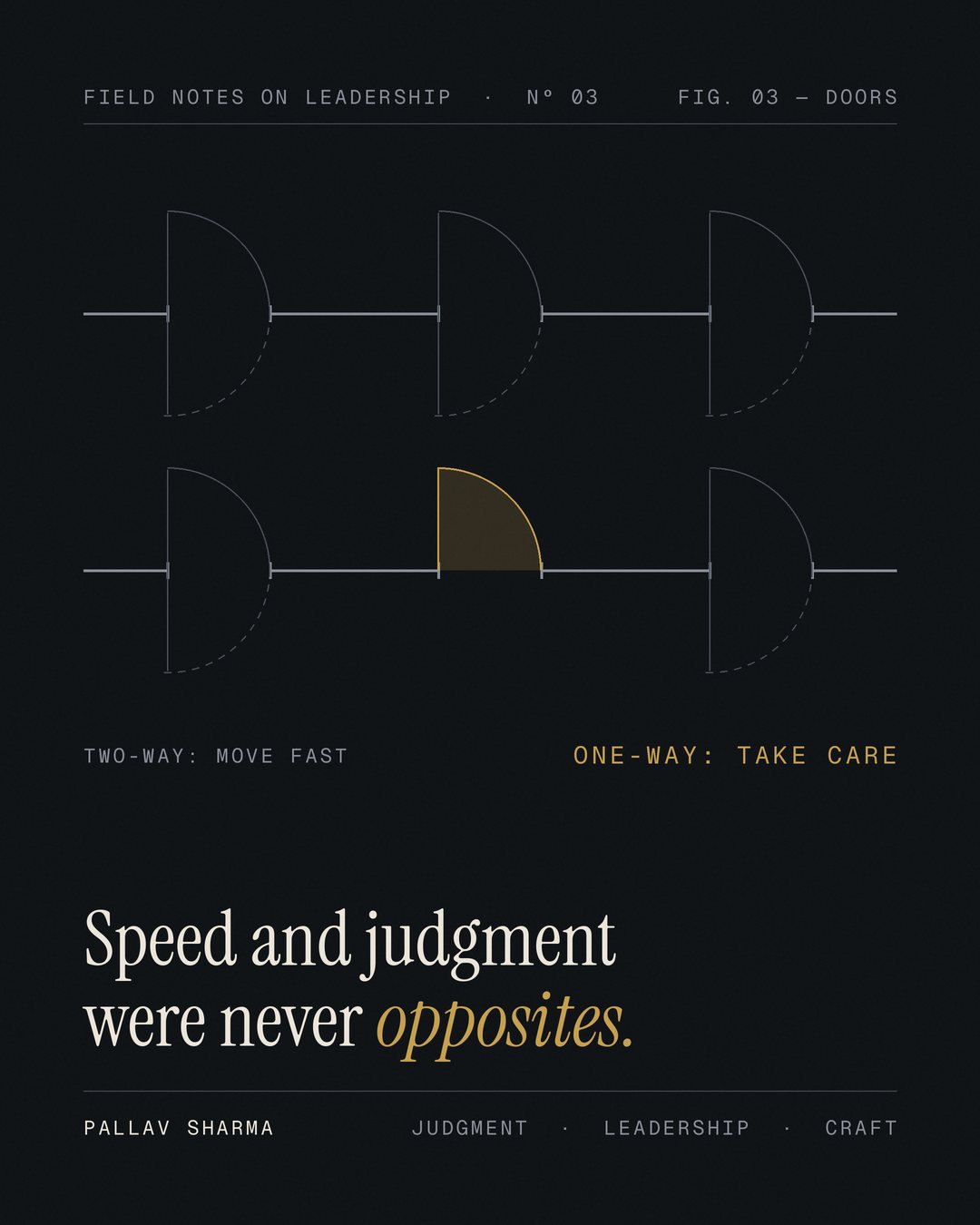
Jeff Bezos called it one-way and two-way doors. It is still the most useful decision filter in business.
Most decisions are two-way doors.
A new process. A tool. A pricing test. A team structure.
If it doesn’t work, you walk back through next week.
A few are one-way doors.
A senior hire. A core architecture. A commitment to a customer.
Two-way doors deserve speed. Bezos suggests deciding with about 70% of the information you wish you had, then letting results teach you the rest.
One-way doors deserve care. Invite disagreement, test the assumptions, and write down why you chose.
The costliest habit in a growing company is treating every door as one-way. Simple choices wait for meetings, and momentum leaks away.
Teams that sort their doors well move faster, learn faster and still get the big calls right.
Speed and judgment were never opposites. Great teams build both.
Going deeper
Jeff Bezos set out this idea in his 2015 letter to Amazon shareholders. Some decisions, he wrote, are consequential and nearly irreversible: one-way doors. Most are changeable and reversible: two-way doors. The reversible kind can and should be made quickly by individuals or small groups with good judgment.
Why growing teams slow down
As organisations grow, they tend to apply the heavyweight process designed for one-way doors to every decision. Bezos named this risk directly. The result is slowness, unnecessary caution and a team that waits for permission on choices it could simply test and adjust.
A simple sorting habit
- Label the door. Every proposal states whether the decision is reversible, and how costly reversing it would be.
- Name one owner and a date. Two-way doors get a single decider and a short deadline.
- Decide with enough, not everything. In his 2016 letter, Bezos suggested most decisions should be made with around 70% of the information you wish you had.
- Give one-way doors real care. Invite disagreement, test the assumptions, run a pre-mortem and write down the reasoning behind the choice.
Disagree and commit
Speed also depends on how a team handles disagreement. Bezos described “disagree and commit”: voice the objection clearly, then commit fully once the decision is made. It keeps momentum without silencing honest debate.
What this gives a team
Teams that sort their doors well spend their caution where it counts and their speed everywhere else. They learn faster from reversible experiments, and they bring full attention to the few calls that shape the company for years.
Speed and judgment work best together, and great leaders build both.

Co-founder & CTO · About