Field notes · Nº 11 Judgment
The most consequential decisions in a company are its defaults.
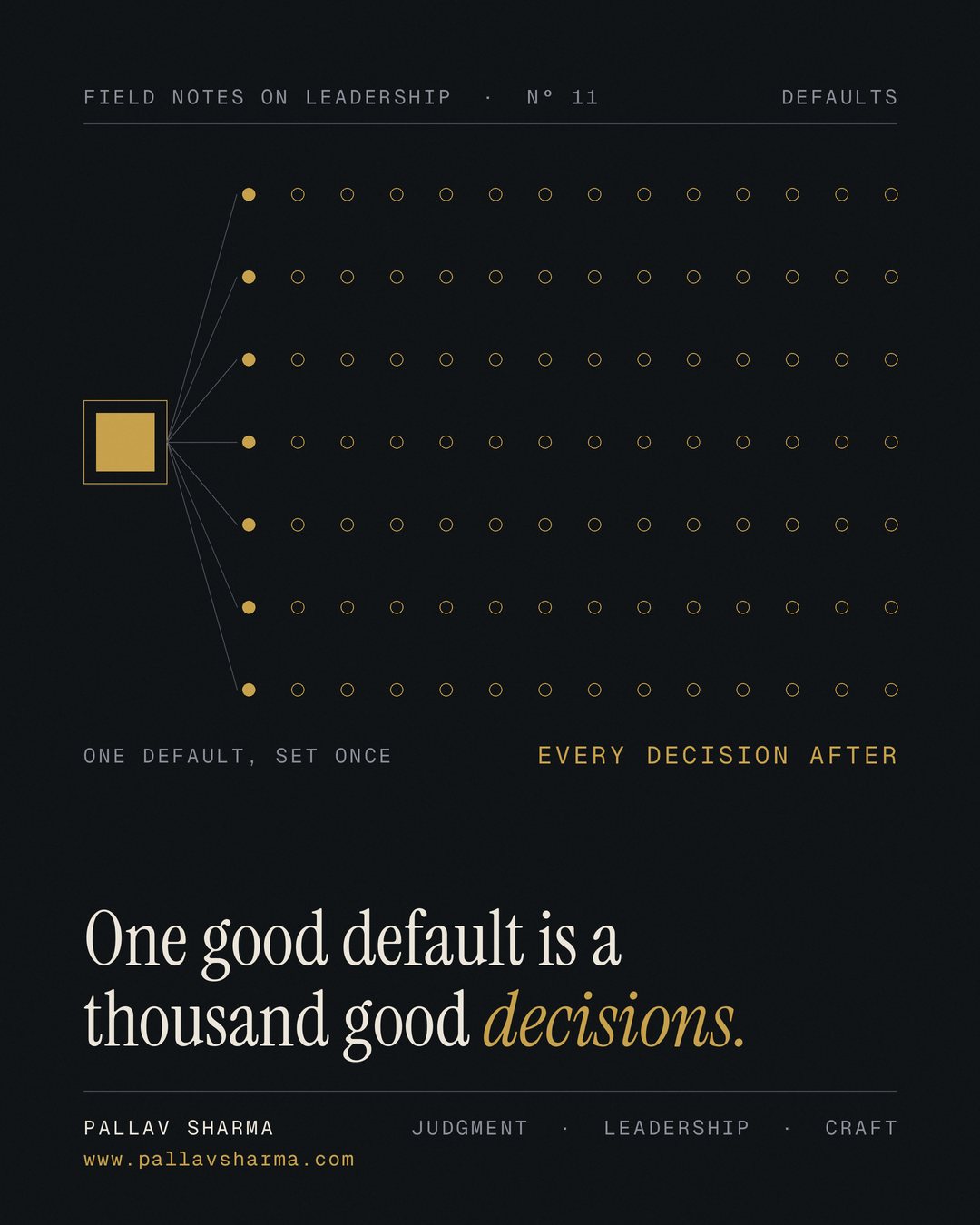
The template every spec starts from. The reviewers every pull request gets automatically. The meeting that recurs until someone cancels it. The option listed first in the deck.
Nobody chooses them twice, so they decide thousands of times a week with no one in the room.
That makes a default the highest-return place to spend judgment. A meeting spends it once. A default spends it on every decision that follows.
One good default is a thousand good decisions.
Going deeper
A default is a decision that keeps working after everyone has forgotten it was made. That is its power, and the reason it deserves more care than almost any single call.
Why it matters
Most choices in a company are never debated. A new project starts from the last project’s template. A pull request goes to whoever the tooling assigns. A weekly meeting continues because it was on the calendar last week. Each of these settings answers a question on behalf of hundreds of people, every day, at no cost in attention.
When a default is right, good behaviour becomes the easy path, and the organisation gets better outcomes without asking anyone for extra effort. Leaders who see this treat defaults as some of the most consequential decisions they own.
A practical method
- Make the defaults visible. List the templates, automatic assignments, recurring meetings, standard settings and first options that shape daily work.
- Ask what each one decides. Write one sentence on the choice it makes for people who never think about it.
- Set it to the standard you want repeated. A spec template that asks for the problem first produces specs that start with the problem.
- Give every default an owner and a review date. Defaults age as the company grows; a named owner keeps them current.
- Change one default at a time, and watch the result. The effect shows up across every team that touches it.
What it looks like in strong teams
New joiners do the right thing on their first day, because the path of least effort is the right path. Recurring meetings each have a clear purpose. Templates carry the questions the company cares about most. Leaders spend less time correcting individual decisions and more time on the few settings that shape all of them.
Choose the defaults with care, and good judgment scales on its own.

Co-founder & CTO · About